How to Make Sure Family From Abroad Doesn't Miss Your Ghana Graduation

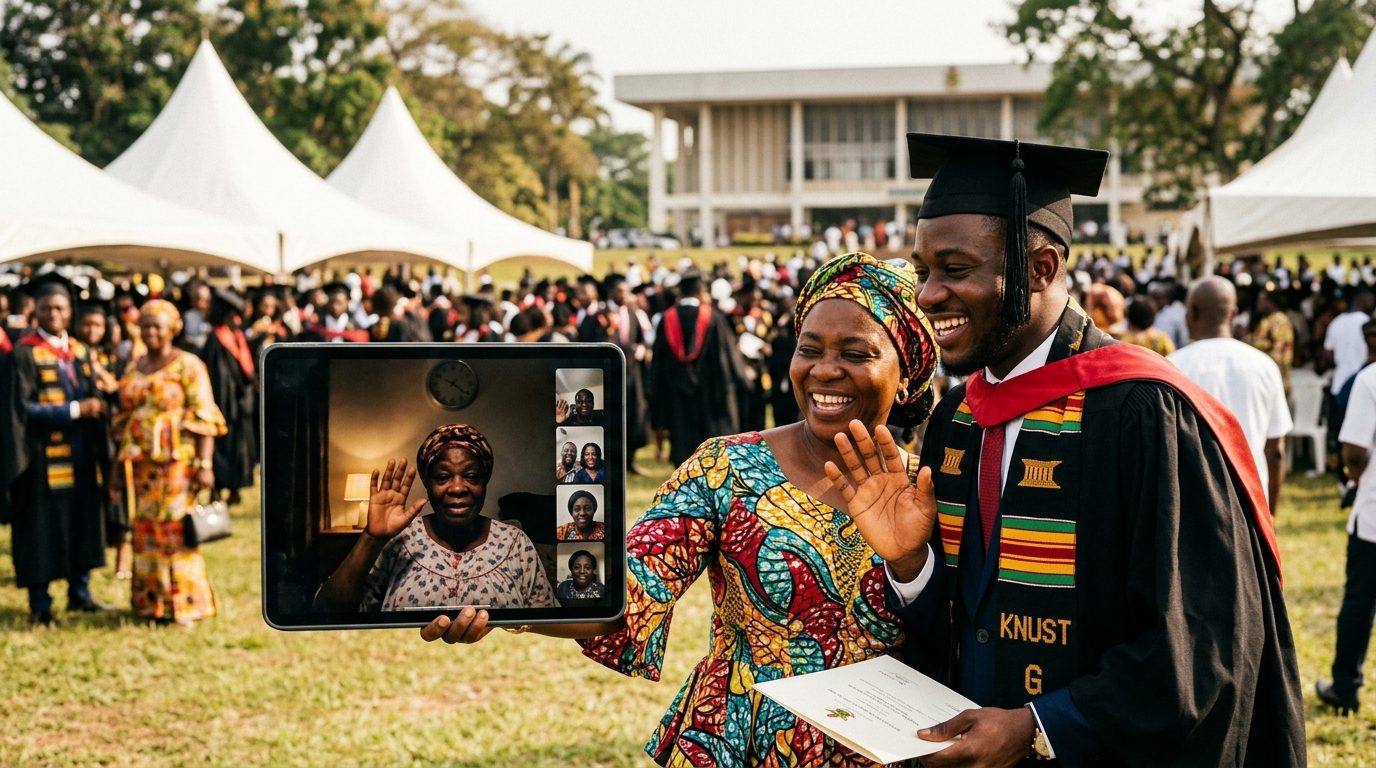
A young man in Kumasi graduated from KNUST last year. His mother was in the front row. His father was in the second. His grandmother, a tall and tireless woman who had paid his first secondary school fees in 2014 when nobody else could, was watching on a phone in Hamburg with a poor connection and a wall clock saying 11 p.m.
A young man in Kumasi graduated from KNUST last year. His mother was in the front row. His father was in the second. His grandmother, a tall and tireless woman who had paid his first secondary school fees in 2014 when nobody else could, was watching on a phone in Hamburg with a poor connection and a wall clock saying 11 p.m.
She missed the moment her grandson crossed the stage because the livestream froze for thirty seconds at exactly the wrong time. She caught the rest, but she did not see the part that mattered to her most.
A Ghanaian graduation that includes diaspora family is not optional in 2026. It is the centre of the work. If a fifth of the people who funded the education live abroad, you cannot mark the graduation as if they don't exist. The good news is that doing this well is not technically hard. Most families just have not thought about it.
Here is how to do it properly.
Start with who, not how
The first mistake families make is to plan the technology before they plan the people.
Before you talk about livestreams and links, write down everybody abroad who needs to be part of this graduation. The aunty in Toronto who paid for first year. The cousin in London who sent the rent during the masters. The uncle in Frankfurt who quietly covered the visa fees. Your grandmother who has called every Sunday for ten years to ask about your grades.
For each person on that list, ask one question: what do they want from this day?
For some, it is just to see the moment you walked across the stage. They will be happy with a 30-second clip. For others, it is to be present for the whole family celebration that comes after, where the elders speak and the toasts happen. They need a longer livestream of the reception, not just the ceremony.
For some, it is to send something back. A message. A gift. A prayer. They need a way to do that on the day, in real time, in a way the family will actually see.
Start with the people. The technology choices follow naturally.
Send the invitation early enough to matter
Diaspora family cannot fly home on two weeks' notice. Even an online attendance plan needs lead time. A diaspora aunty who wants to wake up at 4 a.m. her time to watch your ceremony needs to know about it weeks ahead so she can prepare.
The minimum lead time for a Ghana graduation invitation to the diaspora is four weeks. Six is better. Eight gives the people who might actually fly home time to book flights at a reasonable price.
This is where a JPEG fails most painfully. The cousin in Houston who opens a flyer for the first time at 11 p.m. her time, three days before the ceremony, has been written out of the celebration by the family who sent it. They did not mean to write her out. They just did not give her enough time to be part of it.
A real digital invitation, sent six weeks ahead, opens differently. It loads in her browser at 11 p.m. her time. It shows the ceremony details in HER time zone. It tells her exactly what is going to happen and when, with options for how she can participate. She has six weeks to plan around it. By the day, she is ready.
Three things every diaspora-friendly graduation invitation needs
A graduation invitation that takes the diaspora seriously has three pieces that a flyer does not.
Time-zone aware schedule. The ceremony starts at 10 a.m. GMT. That is 6 a.m. in New York, 10 a.m. in London, 11 a.m. in Berlin, 12 noon in Johannesburg, 7 a.m. in São Paulo. The invitation should show every diaspora guest their own local time without making them do the math. The family in Toronto should not have to subtract four hours. They should see "6 a.m. your time" and know.
A livestream link with a backup. Most universities now stream their own graduation ceremonies on YouTube or Facebook. Find the link from the university's communications office and include it in your invitation. But also plan one family member with a phone to record privately, in case the official stream fails. The aunty in Hamburg who waited up to watch her grandson cross the stage should have two ways to see the moment, not one.
A way to send something back. A message space where diaspora family can leave a note. A MoMo or international payment button if they want to send a gift. A short video upload option so they can record a tribute that gets played during the family reception in Ghana. These are small features that turn passive watchers into participants.
What the day itself should do
Even with the best invitation, the day can still leave the diaspora out if the family on the ground is not prepared.
Three things make the difference.
Somebody in the family is assigned to the diaspora. Their job for the day is to keep the streams running, to read messages aloud during the family celebration, to make sure the cousin in Frankfurt who left a tribute video does not have it ignored. This is a job. Give it to someone.
The toasts and speeches name the diaspora supporters. When the father speaks at the family reception, he should name the aunty in Manchester. By name. With what she contributed. The diaspora aunty who hears her own name spoken at her nephew's graduation, even though she is sitting on a couch in another country, will remember that moment for the rest of her life.
The family takes one group photo for the diaspora, in addition to the family-on-the-ground photo. The group on the ground stands together. Everybody waves at the camera. The diaspora cousins on the livestream are recorded waving back. That photo, on the wall of the family compound, includes everybody who made the day possible.
What I would say to every graduand
Your diaspora family is not an audience. They are a part of the celebration. The difference between treating them as one and treating them as the other is the difference between a graduation they watched and a graduation they were part of.
You will not get the chance to do this again. Treat the invitation as the doorway to the day they will remember for the rest of their lives.
Akwaaba — welcome. Bring everyone home, whether their bodies can make the trip or not. The day is bigger when it includes them properly.
VibeLink builds celebration-ready digital invitations for Ghanaian graduations. If you want your moment honoured properly, we are here.
Edmund Adjekum
Founder of VibeLink Event — building beautiful digital invitations that honour the way Ghanaian families actually celebrate. From weddings in Kumasi to memorials in London, every event deserves an invitation as thoughtful as the moment.