How to Include Your International Family in a Naming Ceremony Without the Confusion

He told me, with regret, that he had assumed the diaspora family would not need much notice for a small ceremony like an outdooring. He had been wrong. And by the time he realised, the day was over and the hurt had set in.
A young father in East Legon told me about his daughter's naming ceremony two years ago. His mother in London had been told the date a week in advance. His aunty in Toronto found out the day before. His cousin in Hamburg only learned about it after seeing photos on Facebook a day later. By the time the ceremony was over, he had three relatives abroad who felt left out, and one of them — the aunty in Toronto — did not call him for two months.
He told me, with regret, that he had assumed the diaspora family would not need much notice for a small ceremony like an outdooring. He had been wrong. And by the time he realised, the day was over and the hurt had set in.
This is the lesson most Ghanaian families learn the hard way. Including international family in a naming ceremony is not optional and not easy. Done well, it deepens the bond between the new baby and the wider family. Done badly, it creates resentments that last years.
Here is how to do it without the confusion.
Why the diaspora cares more than you expect
Most first-time parents underestimate how much the diaspora family wants to be part of a naming ceremony.
A Ghanaian aunty in Toronto who has been waiting for years to see her niece have a baby has been emotionally invested in this child since before the pregnancy was announced. She has prayed for the pregnancy. She has sent money for prenatal care. She has been on calls about names and preparations.
When the baby finally arrives, this aunty does not want to be informed about the outdooring. She wants to be invited. There is a difference.
A first-time parent who treats the diaspora as people to be told rather than people to be invited has misunderstood the relationship. The diaspora aunty is not waiting for an announcement. She is waiting for an invitation.
The notice problem
A Ghanaian naming ceremony is one of the few major family events that happens on a tight timeline. Eight days from birth, in most traditions. There is not a lot of time to give people advance notice.
But there is some time. And the difference between giving the diaspora 48 hours' notice and giving them 6 days' notice is the difference between them feeling included and them feeling forgotten.
The fix is not to delay the ceremony. The fix is to start the diaspora communication before the baby is born.
In the third trimester, you can already tell your diaspora family that the baby is expected. You can tell them the ceremony will happen on the eighth day. You can ask them to keep that approximate window flexible in their schedules. You can ask them to plan for an early-morning livestream depending on their time zone.
When the baby is born, the diaspora is already ready. They know the ceremony is coming. They know roughly when. The 48-hour confirmation that goes out after the birth confirms the actual day, but does not surprise them.
The time zone problem
A Ghanaian outdooring is usually held in the morning. Most start between 8 a.m. and 11 a.m. local time. This works well for the family in Ghana. It does not work well for the diaspora.
A ceremony at 9 a.m. Accra time is: - 9 a.m. in London (during the working day) - 4 a.m. in New York (before sunrise) - 5 a.m. in Toronto - 10 a.m. in Berlin - 7 p.m. in Sydney - 2 a.m. in Los Angeles
For the diaspora to participate, they need to know the time in their own zones, and they need to know it in advance.
The invitation should display the schedule in their time zones automatically. The aunty in Toronto should not have to do math at 5 a.m. The cousin in Berlin should see "10 a.m. your time" and know that her morning coffee will be at the family ceremony.
This is small but significant. Most families do not think about it. The families who do build closer relationships with their diaspora relatives.
The livestream problem
A naming ceremony livestream is harder than a wedding livestream. Outdoorings are intimate. They happen in small spaces. The lighting is uneven. The audio is variable. The ceremony is often quick and includes important moments that are easy to miss.
For the diaspora to feel present, the livestream has to actually work.
Three things make the difference.
A real camera, not a phone propped against a chair. A simple smartphone on a small tripod is the minimum. A wired or wireless microphone connected to the streaming device is even better.
Tested in advance. The day before the ceremony, set up the stream and have a family member abroad confirm they can see and hear clearly. Adjust if needed.
Managed by one designated person. The cousin who is on phone duty, the aunty who is taking videos, the brother who is making sure the stream stays up — these are three different jobs. The diaspora stream needs its own person, not whoever happens to be free.
A diaspora aunty who watches a ceremony where the livestream fails for the most important three minutes carries that disappointment for years. She does not blame the technology. She blames the family for not caring enough to make it work.
The contribution problem
Many Ghanaian families now expect contributions toward the baby's first savings or future school fund. This is a positive tradition. The diaspora wants to contribute. The diaspora struggles to do so.
A first-time father who relies on MoMo for contributions cuts out his diaspora family entirely. The aunty in Toronto cannot send to a Ghana MoMo number without seven separate WhatsApp messages and a wire transfer she does not have time to set up.
The fix is to set up an international payment route alongside the MoMo. A simple online payment link the aunty can use from her phone in 30 seconds. A bank account the diaspora can transfer to. Even a PayPal address.
The point is not the payment platform. The point is that the diaspora can contribute as easily as the local family. When they can, they often contribute more than the local family. When they cannot, they feel left out of the financial expression of welcome that the ceremony is meant to be.
What the day itself should do for the diaspora
Even with the best invitation, the best livestream, and the best contribution route, the day itself can still leave the diaspora feeling like outsiders.
The MC or the elder leading the ceremony should name the diaspora family members during the introductions. By name. With where they are watching from. This takes 90 seconds. It is the most touching 90 seconds of many ceremonies.
The diaspora tribute messages should be read aloud during the family meal. The aunty in Toronto who wrote three lines about how grateful she is to see her niece become a mother deserves to have those three lines heard.
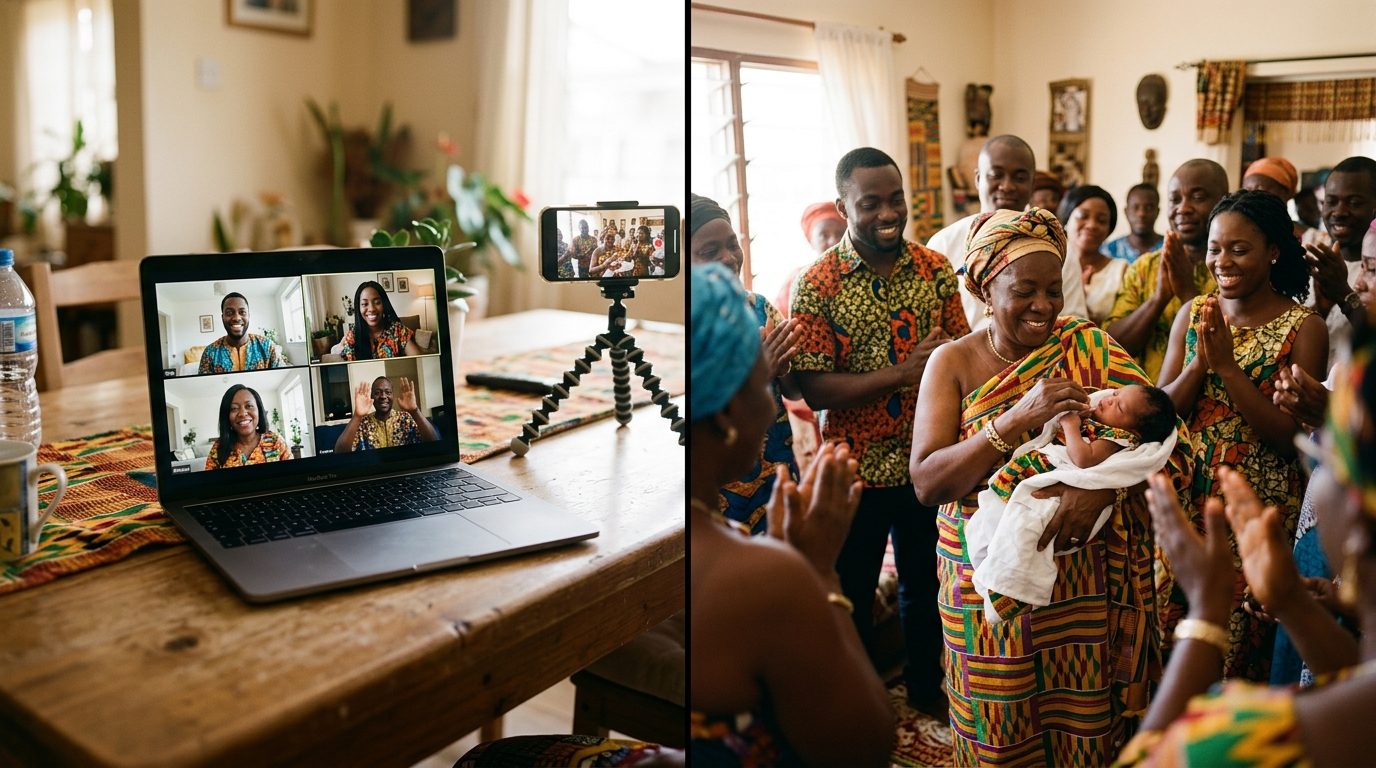
A group photograph should include the diaspora screens. The family in Ghana stands together. The diaspora cousins on the laptops and phones wave from their squares. Someone photographs the whole scene. That photograph ends up in the family compound, and it includes everybody.
What I would say to every new parent
Your diaspora family is not an inconvenience. They are the wider arms of the family that has just welcomed your child. Treat them like the arms they are.
Give them notice before the baby is born. Send the invitation properly within 48 hours of the birth. Display the schedule in their time zones. Build a livestream that actually works. Open a contribution route they can use. Name them on the day.
Six things. None of them difficult. All of them invisible if you miss them and unforgettable if you do them right.
Akwaaba — welcome. The wider family is watching, all of them, wherever they are. Build the day so they can be part of it.
VibeLink builds welcoming digital outdooring invitations for Ghanaian families. If you want to introduce your baby to the world properly, we are here.
Edmund Adjekum
Founder of VibeLink Event — building beautiful digital invitations that honour the way Ghanaian families actually celebrate. From weddings in Kumasi to memorials in London, every event deserves an invitation as thoughtful as the moment.