Grief Is Already Heavy Enough — Here's How Families Are Handling Funeral Announcements Differently Now

By the time the funeral happened, she could not remember if she had told her father's old school friend or not. She had not. He learned about the funeral from someone else, three days after the burial.
A week after her father died, a woman in Accra opened her phone and realised she had been sending the funeral details to people for nine days straight. Different versions, depending on who she was texting. The full version for close family. A shorter version for the elders. A different version for her father's colleagues. The same details, typed out by hand, twenty or thirty times a day, while she was also grieving the man who had raised her.
By the time the funeral happened, she could not remember if she had told her father's old school friend or not. She had not. He learned about the funeral from someone else, three days after the burial.
This is not a story about technology. It is a story about how Ghanaian families have been handling funeral announcements, and how the families who handle it differently are sparing themselves a category of pain that nobody talks about.
The grief is already heavy. The administration of the grief does not need to add to it.
The old way of announcing a Ghanaian funeral worked when communities were smaller and lived together. The town crier walked through the village. The chief was informed. The elders gathered. News reached everybody who needed to know without anyone having to type anything.
In 2026, Ghanaian families are spread across cities, across continents, across networks the deceased never met but the family member did. A modern Ghanaian funeral has to announce itself to hundreds of people, in dozens of different relational contexts, using channels that did not exist twenty years ago.
The families who do this manually — the bereaved daughter typing the same WhatsApp message thirty times a day — pay a cost most people do not see.
They pay it in exhaustion during the very week they should be resting.
They pay it in mistakes. The colleague who got the wrong date. The cousin who never got the message. The diaspora aunty who learned of the death from a Facebook post.
They pay it in regret. Six months later, the daughter still wonders if she communicated the funeral well enough. Six years later, she still wonders.
This cost is preventable. The families who prevent it use one simple shift.
The single shift that changes everything
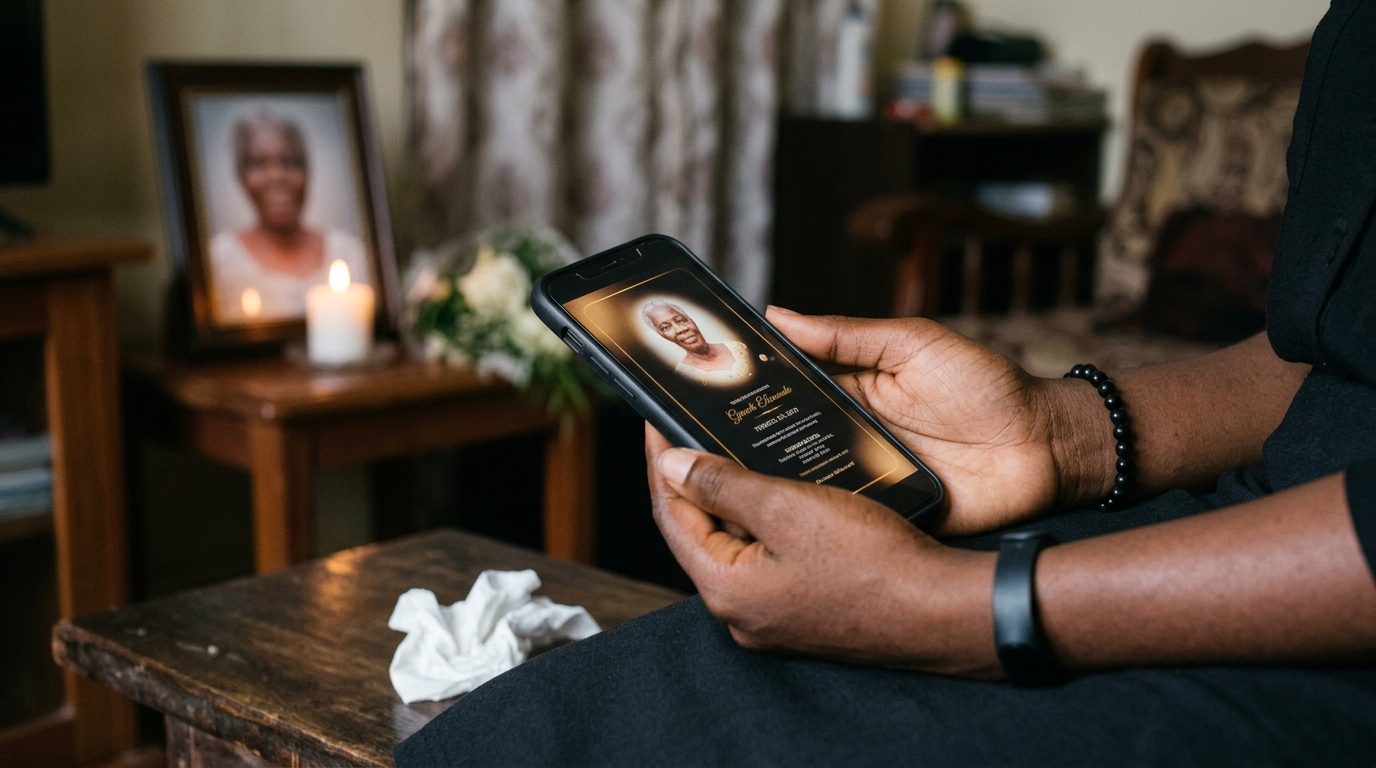
The shift is this. Instead of sending the funeral details to each person individually, the family creates one place where all the information lives, and shares the link to that place.
That place is the memorial page.
It has the deceased's photograph. It has the obituary. It has the funeral schedule. It has the venue. It has the dress code. It has the diaspora livestream link. It has the contribution channels. It has the condolence book.
The family creates this page once, on the second or third day after the death, and shares the link in every WhatsApp group, every email, every social media post. The link is the announcement.
Each recipient opens the link. Each recipient sees the same information. Each recipient has a way to RSVP, to leave a condolence, to send a contribution, to share the link with one more person who needs to know.
The bereaved family member no longer types the same message thirty times a day. They make one decision — the link — and the link does the work.
What changes when the work is offloaded
Three things change immediately for the bereaved family.
The administrative burden disappears. The hours that used to be spent in WhatsApp typing messages are now spent in the family compound, with the family, in the way grief is supposed to be processed. The family member who would have been on their phone all week is, instead, sitting with the elders and helping with the funeral planning that actually matters.
The information becomes consistent. Everybody who learns about the funeral learns it from the same source. The date does not get garbled. The venue does not get misremembered. The diaspora cousin who would have heard a wrong time hears the right one because there is only one source of truth.
The reach goes further. The link can be forwarded by any recipient to anyone they think should know. A colleague forwards it to other colleagues. A church friend forwards it to other church friends. The reach of the announcement multiplies without any additional work from the family.
The family saves the energy, the information stays clean, and more people learn about the funeral. All three of these are improvements.
What the page should actually have
A funeral announcement page should not be elaborate. It should be clear, dignified, and complete. Five sections are enough.
The deceased's photograph and full name at the top. Properly framed, with the dates of birth and death. This is the first thing every visitor sees.
A short obituary. Three to six paragraphs. Where they were born. Who their parents were. What they did with their life. What they were known for. Who survived them. This is what the rest of the family wants to know, and what new friends and colleagues will read with care.
The funeral schedule. All the relevant dates and times. The one-week observation. The wake-keeping. The church service. The burial. The reception. The 40-day rite if relevant.
The venues, with maps. Where the funeral hall is. Where the burial is taking place. How to get there. Where to park if it is in the city. Where to stay if guests are travelling from out of town.
The participation options. The diaspora livestream link if applicable. The condolence book. The contribution channels. A way for guests to RSVP if the family needs a headcount.
That is the entire page. It does not need bells and whistles. It needs to be complete and clear.
Why this matters specifically for Ghanaian families
The reason this approach has been so quickly adopted by thoughtful Ghanaian families is that Ghanaian funerals are large. A typical funeral in 2026 reaches between 200 and 800 people across multiple cities, churches, professional networks, and diaspora communities. To inform that many people manually is impossible. To inform them through a single link is straightforward.
There is also something deeply Ghanaian about the page itself. A traditional Ghanaian funeral has always built something for the deceased — a hall, a programme, a procession, a meal. The memorial page is the new addition to that list. It is something the family builds together, in the days after the death, that honours the deceased and serves the living.
It is, in its own quiet way, an act of love.
What I would say to anybody who has just lost someone
You will be tempted to handle the announcements yourself, by hand, in the days after the death. You will think you have the energy for it. You will believe nobody else can do it the way you would.
You do not have the energy. The grief will take more than you expect. The hand-typing of messages will keep you on your phone in the moments when your family needs you in the room.
Let the page do the work. Build it once, share the link, and put the phone down.
The deceased deserves a properly honoured funeral. You deserve a chance to actually grieve. Both are possible with the right approach.
Nyame nhyira no — God bless him or her. Let the grief have its proper weight. Take the rest off your shoulders.
VibeLink builds dignified digital memorial pages for Ghanaian families. If your family is preparing to honour someone, we are here.
Edmund Adjekum
Founder of VibeLink Event — building beautiful digital invitations that honour the way Ghanaian families actually celebrate. From weddings in Kumasi to memorials in London, every event deserves an invitation as thoughtful as the moment.