One-Week Announcements, Final Funeral Rites & Everything In Between — A Complete Guide

A Ghanaian funeral is not an event. It is a sequence of ceremonies that begins on the day of death and continues for years afterwards. Families who understand the full sequence plan it well. Families who treat it as a single event often miss the moments that matter most.
A Ghanaian funeral is not an event. It is a sequence of ceremonies that begins on the day of death and continues for years afterwards. Families who understand the full sequence plan it well. Families who treat it as a single event often miss the moments that matter most.
This article walks through the full Ghanaian funeral timeline, what each stage is for, and how thoughtful families now mark each one.
A note before we begin. Different ethnic groups in Ghana mark these stages differently. Akan, Ewe, Ga, and Northern traditions all have their own customs and timings. What follows is a general framework. The specifics for your family come from your elders, your hometown, your church, and your own tradition.
Day 0 — the death
The first call is the family call. The closest relative is informed. The family WhatsApp groups are quietly notified. The hospital, the home, or the place of death is settled. The body is moved.
The first decisions are urgent. Where is the burial taking place — Accra, the hometown, somewhere else? What is the rough budget? Who is in charge of which arrangements? A core planning group of four or five people is identified within the first 24 hours. Their job is to coordinate everything that comes next.
This is not the moment for the wider announcement. That comes later, when the dates are set.
Days 1 to 3 — quiet planning
The family meets. The funeral committee is formed. Roles are assigned: financial, programme, food, accommodation, transport, communication. The hometown is consulted. The chief or elder is informed if customary rites require it. The church is approached. A date for the burial is tentatively set.
Most importantly, in 2026, the family begins thinking about how the announcement and the funeral itself will be communicated. A memorial page is started. The obituary is drafted. The first photographs of the deceased are gathered.
Days 4 to 8 — the announcement
Around the end of the first week, the family is ready to announce. The wider relatives are informed. The deceased's professional and social circles learn the news. The diaspora family who have not yet been told are formally informed.
In modern Ghanaian practice, this is when the memorial page goes live and is shared widely. A proper obituary is published with it. The funeral schedule, if known, is included. Condolences begin to come in via the page, via phone, via in-person visits to the family house.
Day 8 — the one-week observation
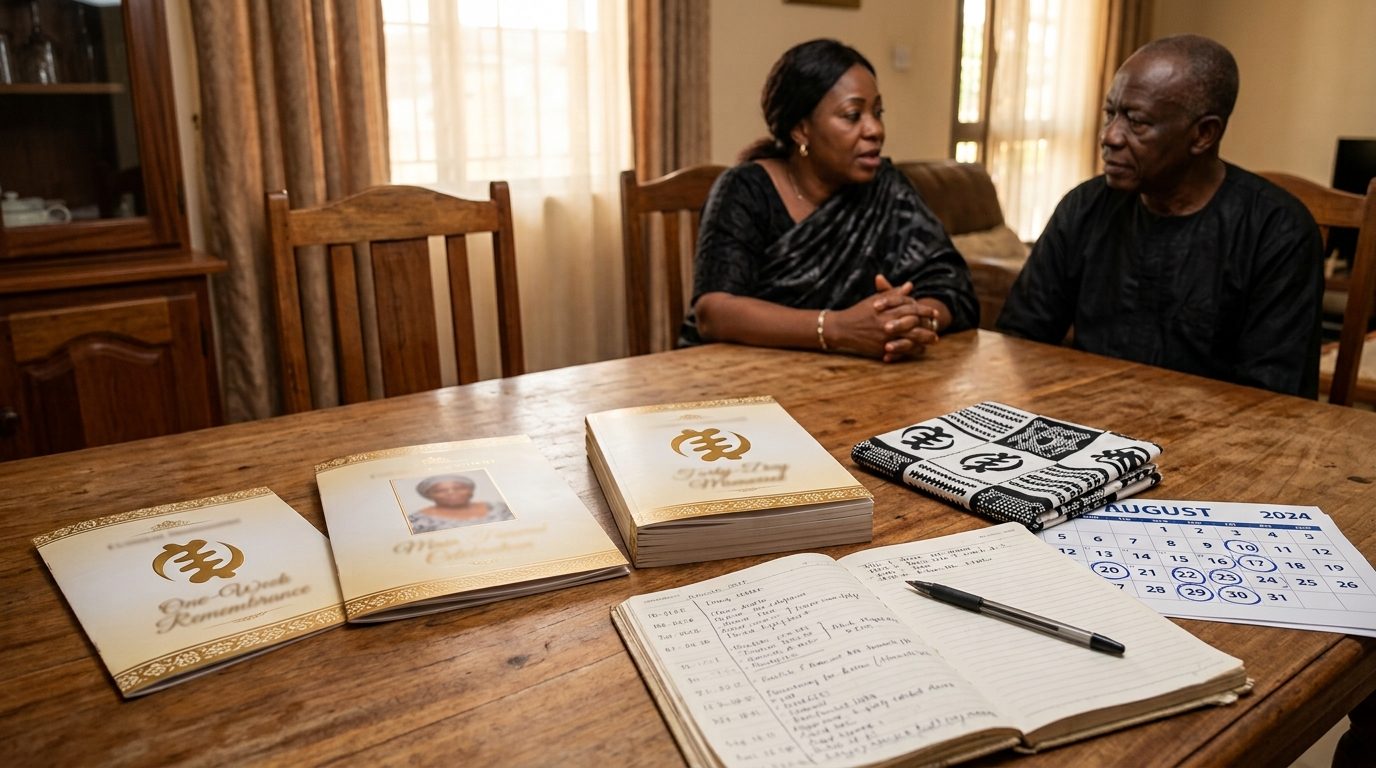
In Akan tradition and most Southern Ghanaian customs, the eighth day after the death is a significant marker. It is the day the family formally gathers, the day the wider community comes to express condolences, and the day the funeral arrangements are usually confirmed publicly.
The one-week is not the funeral. It is the announcement of the funeral.
A well-run one-week observation includes a small gathering at the family house, a short tribute to the deceased, the formal announcement of the burial date, and the receipt of condolences from neighbours, colleagues, and extended family. Refreshments are served. The atmosphere is grave but not yet at the weight of the final funeral.
This is the moment when most families now formally share the memorial page link, finalise the diaspora livestream plans, and confirm the contribution channels. The one-week observation prepares the family and the community for the larger event that is to come.
Days 9 to the burial — final preparation
Depending on the family and the resources, the burial can happen anywhere from two weeks after death to six months after. Wealthier families with diaspora coordination requirements often plan for two to three months out. Families with simpler arrangements may bury within two weeks.
This is the period when the heavy lifting of funeral planning happens. The Order of Service is designed and printed. The biography booklet is written and printed. The hall is booked. The catering is arranged. The choir is rehearsed. The pallbearers are confirmed. The lying-in-state schedule is set. The procession route is planned.
It is also the period when the digital infrastructure for the funeral is completed. The memorial page is updated with the final schedule. The livestream is tested. The condolence book begins to fill with messages from people who cannot attend in person. Tribute videos from diaspora family arrive and are organised.
The day of the funeral
A modern Ghanaian funeral typically unfolds over a full day, sometimes spread across two or three. The wake-keeping in the night before, the church service in the morning, the burial in the afternoon, the family gathering in the evening.
Each segment is its own ceremony with its own programme and its own dignity.
For families with a strong digital plan, this is also the day the livestream runs continuously through the major moments. The diaspora aunty in Hamburg watches the entire church service from her kitchen. The cousin in Toronto joins the family gathering virtually in the evening. The memorial page is updated in real time with photographs.
By the end of the day, the deceased has been honoured in a way the family will remember for the rest of their lives.
Day after the burial — the immediate after
The day after a Ghanaian funeral is often missed in the planning. It is, in fact, one of the most important days.
The family is exhausted. Visitors are still arriving. Final accounts are being settled with vendors. The hall has to be cleaned. The leftover food has to be distributed. The hired transport returns its receipts. The pastor or imam is paid their honorarium.
In modern practice, this is also the day the photographs from the funeral are uploaded to the memorial page. The diaspora family who watched virtually now has the chance to see the full coverage of the day they could not attend physically. Tribute messages continue to arrive on the condolence book.
A family that has planned well treats this day with the same care as the funeral itself. A family that has not often discovers, ten days later, that important relationships were strained because some piece of the post-funeral process was missed.
Day 40 — the forty-day rite
In many Ghanaian traditions, particularly Akan, the fortieth day after the burial is marked with another ceremony. A short church service. A family gathering. A meal. A formal end to the most intense period of mourning.
The 40-day is smaller than the funeral itself. It is more reflective. It is the family checking in on each other and on the memory of the deceased.
In modern practice, families now use this day to update the memorial page with a short reflection, to share the final accounting of contributions received, and to thank everybody who helped during the funeral period. A small post on the memorial page, or a quiet email to all the contributors, closes a loop that previous generations of Ghanaian families closed in person.
The one-year anniversary
The one-year is a quieter ceremony. A meal at home. A visit to the grave. A short prayer. A family conversation about how the year has gone.
This is the moment when modern families revisit the memorial page. The widow reads the condolence book again. The children show the page to grandchildren who were too young to remember the funeral. The page becomes the place where the family returns each year to remember.
What I would say to every family
A Ghanaian funeral is not one day. It is a year-long process with a series of significant markers, and the family who plans for all of them has a different experience from the family who plans only for the burial.
Sit down at the start. Map out every stage. Decide who is responsible for what at each stage. Build a memorial page that carries the family through the entire year, not just the funeral day.
The dignity of a Ghanaian funeral is not in any single ceremony. It is in the care taken across all of them.
Nyame nhyira no — God bless him or her. Each stage matters. Honour them all.
VibeLink builds dignified digital memorial pages for Ghanaian families. If your family is preparing to honour someone, we are here.
Edmund Adjekum
Founder of VibeLink Event — building beautiful digital invitations that honour the way Ghanaian families actually celebrate. From weddings in Kumasi to memorials in London, every event deserves an invitation as thoughtful as the moment.