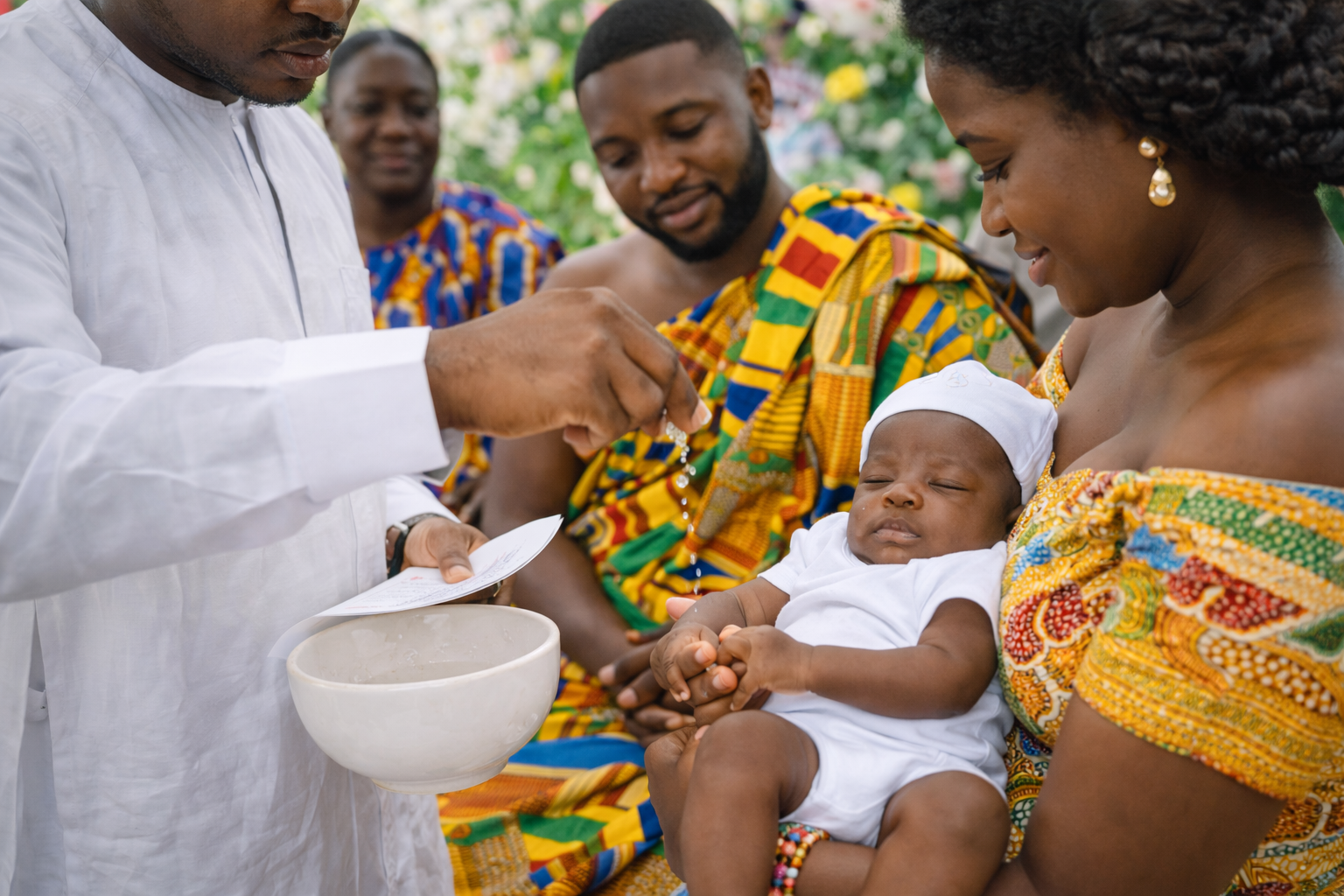
A first-time Christian Ghanaian mother sent me a long message last December. Her parents were Methodist. Her in-laws were Akan. She had a one-month-old daughter and a quietly tense family situation. Her parents wanted a christening at their church. Her in-laws wanted an outdooring at the family compound. Everybody thought the other side was being difficult. Everybody loved the baby.
This is one of the most common dilemmas Ghanaian families face, and most of them work it out without ever fully understanding the distinction between the two ceremonies. The result is often two events that feel like they are competing, when they should be complementing.
Here is the actual difference between an outdooring and a christening, and how thoughtful Ghanaian families now celebrate both properly.
What an outdooring actually isThe outdooring, in Akan, Ga, Ewe and most Southern Ghanaian traditions, is a customary rite. It happens on the eighth day after the birth. It is a moment in which the newborn, who has spent the first seven days protected within the household, is formally introduced to the wider family and the community.
The ceremony is structured around tradition. An elder performs libation. The name is announced. The lineage is named. The baby is symbolically presented to the world. Older family members hold the baby. Blessings are spoken. A meal is shared.
The outdooring is not a Christian ceremony. It is not a Muslim ceremony. It is a Ghanaian customary ceremony, predating both, observed by many Ghanaian families regardless of their religious affiliation. A Muslim family in Tamale and a Catholic family in Kumasi may both have an outdooring, and both ceremonies will look broadly similar in structure.
What the outdooring is doing is establishing the baby's place in the family and the community. It is a cultural induction.
What a christening actually isThe christening, sometimes called a baptism depending on the denomination, is a Christian sacrament. The baby is presented at the church, the parents and godparents make commitments on the child's behalf, the minister baptises the baby with water in the name of the Father, the Son, and the Holy Spirit, and the baby is welcomed into the Christian community.
This is a religious ceremony with theological significance. It marks the baby's entry into the Christian faith and is observed by the church.
A christening can happen at different ages depending on the denomination. Catholic and Anglican families often christen within the first few months. Methodist and Presbyterian families have similar timing. Some Pentecostal denominations practice dedication of infants and adult baptism later.
What the christening is doing is welcoming the baby into a community of faith. It is a spiritual induction.
Why families confuse themMost Ghanaian Christian families now do both. The outdooring on the eighth day, often at home with extended family. The christening on a later Sunday at the church, often with godparents and the wider church community.
The confusion arises when families try to combine the two ceremonies into one, or when one side of the family treats one ceremony as more important than the other.
Most often the confusion is about identity. Some Christian parents feel that the customary outdooring is in tension with their faith. Some traditional families feel that the church christening sidelines the family's customs. Both views are common. Both are usually mistaken.
The customary outdooring and the Christian christening are not competing. They are doing different things. One inducts the baby into the family. The other inducts the baby into a community of faith. A Ghanaian Christian child can be inducted into both, in different ceremonies, without the family feeling pulled apart.
How to celebrate both properlyIf your family observes both ceremonies, here is how thoughtful Ghanaian families now structure them.
The outdooring on the eighth day, at home, with the extended family
The elder performs the customary rites. The name is announced. The lineage is honoured. Blessings are spoken. The baby is presented to the family and the community. The ceremony is small, intimate, deeply rooted in the family tradition. This is where the family's cultural identity is passed to the next generation.
The christening on a chosen Sunday, at the church, with godparents and the wider church community
The pastor or priest performs the sacrament. The parents make their public commitments. The baby is baptised or dedicated. The church welcomes the baby. The ceremony is held in a sanctuary, with hymns and prayers, and often followed by a reception at the family home.
These are two events, both real, both significant, both deserving of attention.
The mistake is to treat them as the same event. They are not. The outdooring is a cultural rite that the family has been observing for generations. The christening is a sacrament of the church. Combining them into one ceremony usually weakens both.
Holding them separately, with proper attention to each, honours the full identity of a Ghanaian Christian child. The family knows who they are. The church knows who they are. The baby grows up understanding that both communities have welcomed them.
What this looks like in practiceA modern Ghanaian Christian family that holds both ceremonies typically plans them this way.
The outdooring is planned during the third trimester of the pregnancy. The elder is identified. The family compound or home is prepared. The name is chosen. The invitation goes out within 48 hours of the birth. The ceremony happens on the eighth day. The diaspora joins via livestream. The family is fed. The baby is named.
The christening is planned two to three months ahead, after the outdooring. The Sunday is chosen with the church. The godparents are identified and confirmed. The minister is consulted. The reception is planned. The diaspora is invited again, this time with the church service livestreamed instead of the home ceremony. The baby is baptised.
The two ceremonies are connected but distinct. They have different programmes, different settings, different guests in many cases. The customary side of the family is most active in the outdooring. The church community is most active in the christening.
This is how Ghanaian Christian families have learned to honour both their cultural and their religious identities at the same time, without making either compromise the other.
The invitation questionFor families holding both ceremonies, the invitation question is worth addressing directly.
The outdooring invitation and the christening invitation should be separate. Different design, different tone, different schedule. The outdooring invitation reflects the family's customary tradition. The christening invitation reflects the family's church tradition.
A single combined invitation tries to do both and usually does neither well. Two clear, separate invitations let each ceremony speak for itself.
The diaspora family receives both invitations. They may attend only one, or follow both via livestream, or send tributes for both. The invitations themselves give them the structure to participate in whichever they can.
What I would say to families facing this questionIf your family is Christian and your tradition supports an outdooring, do both. Plan each one with full intention. Build each one to honour what it is meant to honour.
The baby will grow up understanding that they were welcomed by both the family and the church, in two separate ceremonies, with two separate communities, both saying the same thing: we see you, we celebrate you, we will carry your story.
This is a gift only Ghanaian Christian families can give. It is worth giving properly.
VibeLink builds welcoming digital outdooring invitations for Ghanaian families.
If you want to introduce your baby to the world properly, we are here.
Found this useful? Share it