What a Proper Ghanaian Funeral Program Should Include (Most Families Miss 3 of These)

When a Ghanaian family puts together a funeral programme, the instinct is to make it longer. More tributes. More photos. More pages. The thinking is that volume equals dignity.
When a Ghanaian family puts together a funeral programme, the instinct is to make it longer. More tributes. More photos. More pages. The thinking is that volume equals dignity.
After reading many Ghanaian funeral programmes, I have come to believe the opposite. A dignified programme is not a long one. It is a specific one. The page count matters less than the names, the places, and the moments inside it.
Here is what every Ghanaian funeral programme must include, and the three things most families quietly leave out without realising what they are losing.
The basics every family gets right
Most families remember the standard elements:
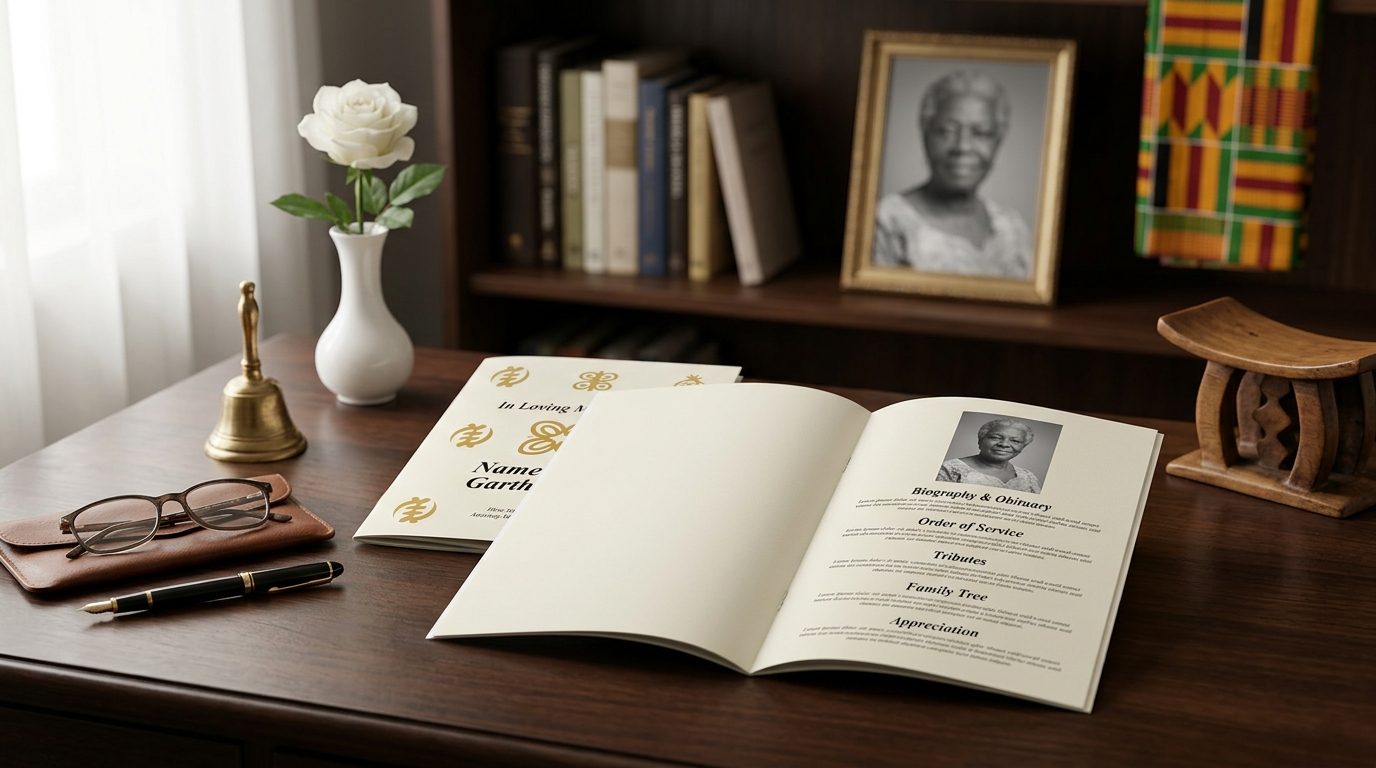
- The cover with photograph, full names, and dates. - The Order of Service for the church. - A biography of the deceased. - Tributes from the spouse, the children, and the church. - The closing committal. - An acknowledgement page.
If you have these six elements, you have the bones of a proper programme. But the bones are not what families return to a year later. The flesh is.
Here is what most families miss.
Missed item 1: the specific hometown, the lineage, the *abusua*
Most biographies start with the wrong sentence. "He was born in 1948 in the Eastern Region." That sentence is accurate. It is also empty.
A proper Ghanaian biography starts with: "He was born on 14th March 1948 in a small house in Asuoyeboah, Kumasi, to Lawrence Sakyiama and Lydia Korowaa." The hometown, the parents' names, and the date should be inside the first three lines. Then the abusua (the family clan) should be named within the first page.
This is not formality. It is identity. A Ghanaian elder is not just a person. He is the descendant of a lineage, the carrier of a clan name, the citizen of a particular village or town. When the biography starts with vague geography and generic ancestry, the funeral itself feels generic.
Specificity is the first act of dignity. The more specific the biography, the more honoured the life.
Missed item 2: a tribute from the grandchildren
Many families think grandchildren are too young to write a tribute. So they leave them out, or include them only as part of a generic family note at the end.
This is a mistake. Even a five-year-old grandchild has something to say about a grandparent. Their words may be short, simple, or unstructured. "Grandpa always gave me sweets when nobody was looking." That is the tribute. Print it.
Why does this matter? Because in twenty years, when that grandchild is twenty-five and reading through the programme again, they will see what they wrote at five and understand that they were part of the family record from the very beginning. That single sentence is not just a tribute to the deceased. It is a gift to the child who will one day reread it.
In every funeral programme I have seen that includes grandchildren's voices, those pages are the ones the family treasures most. Yet they are the pages families most often skip.
Missed item 3: the digital memorial layer
This is the newest of the three, and the most consequential.
A printed programme tells the story of the deceased on one day. The day of the funeral. After that, the programme sits on a shelf. Some family members read it once. Most do not read it again. Diaspora family who could not fly home for the funeral may not receive a copy at all.
A digital memorial page changes that completely. It carries:
- The full biography in long form, with photographs that did not fit in the print. - The livestream of the service, for the cousins who watched from London or Toronto and now want to revisit. - The tributes that arrive in the weeks after the burial, when grief shifts and people find their words. - A condolence book that family worldwide can write into for years. - Anniversary updates, where the family adds a note on the first, third, tenth anniversary.
This is not optional in 2026. If your family has even modest diaspora attendance, with a son in London, a daughter in Toronto, or grandchildren scattered between Accra and Lagos, the memorial page is where the funeral keeps living.
The QR code on the back of the printed programme is what links the two layers together. One layer for the day, one layer for the long memory.
How to plan around the three
If you are preparing a funeral in the coming weeks, here is the simple guidance:
1. Spend an extra hour on the biography. Ask the eldest sibling for the specific village, the parents' names, the year the deceased moved to Accra. Do not let "Eastern Region" or "Kumasi area" be good enough. 2. Ask every grandchild, even the youngest, for one sentence. Help the small ones write theirs if needed. Print every sentence, in their own voice. 3. Decide the digital memorial layer before you commit to the printer. The printed programme should be shorter and more meaningful because the digital page is carrying the rest.
Most Ghanaian families spend GHS 15,000 to 25,000 on a printed programme that fails on all three of these points. A smaller printed programme done well, paired with a dignified digital memorial, costs less and lasts longer.
Onyame nkasa — God speaks. He speaks through the way we remember the people we have lost. Make sure the remembering is specific, includes every voice, and lasts beyond the day.
VibeLink builds dignified digital memorial pages for Ghanaian families. If your family is preparing to honour someone, we are here.
Edmund Adjekum
Founder of VibeLink Event — building beautiful digital invitations that honour the way Ghanaian families actually celebrate. From weddings in Kumasi to memorials in London, every event deserves an invitation as thoughtful as the moment.