Why a Corporate Event Starts the Moment You Send the Invitation

A Ghanaian fintech CEO told me last quarter that his product launch had been "successful but disappointing." 220 of the 300 expected guests attended. The keynote went well. The product demo was clean. The press picked up the story. By any objective measure, the launch worked.
A Ghanaian fintech CEO told me last quarter that his product launch had been "successful but disappointing." 220 of the 300 expected guests attended. The keynote went well. The product demo was clean. The press picked up the story. By any objective measure, the launch worked.
But he was disappointed because three of the most senior people he had invited did not come. One was a director general. One was a venture investor he had been courting for a year. One was the head of a competitor he had wanted to publicly impress. All three had received invitations. None of them had RSVP'd. None of them had attended.
When he reviewed what had gone wrong, he traced it back to the same point. The invitations had gone out three weeks before the launch, by email, as a PDF attachment, with no follow-up reminder, no calendar integration, and no clear RSVP. The invitations had been sent. They had not been received in any meaningful sense.
This is the lesson most Ghanaian companies learn the hard way. A corporate event does not start when the doors open. It starts the moment the invitation goes out.
The 30-day pre-event window
For most Ghanaian corporate events, the four to six weeks before the event are the period in which attendance is actually built. Not the event itself.
In this window, three things have to happen.
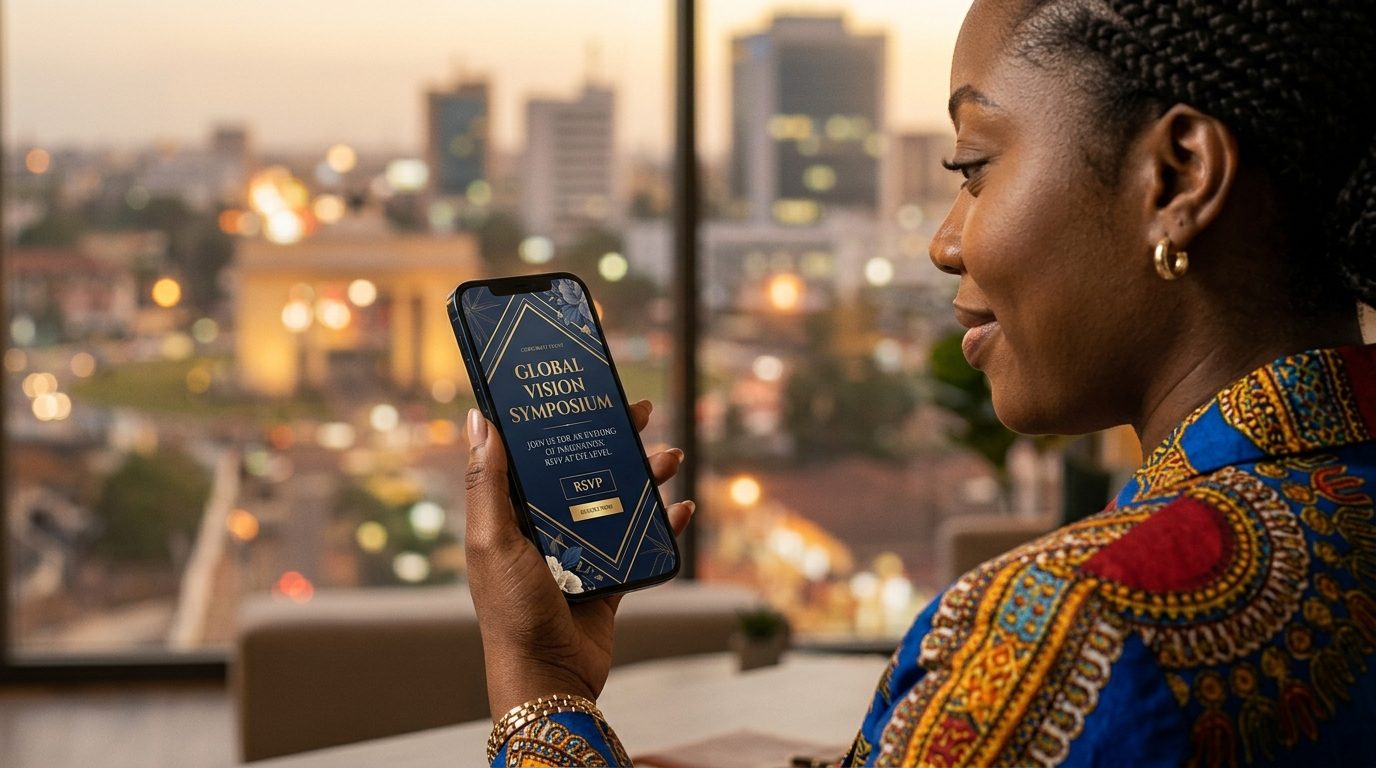
The invited guests have to receive the invitation in a format they take seriously. A PDF attachment in an inbox at midnight is not taken seriously. A proper invitation with the company's branding, with the event details cleanly presented, with an RSVP button that works on mobile, is taken seriously.
They have to be reminded as the event approaches. A senior executive who confirms three weeks ahead needs to be reminded one week ahead. Without a reminder, the calendar event slides. The competing meeting gets accepted. The original invitation is forgotten.
They have to be given a reason to prioritise this event over the others competing for their time. The invitation itself has to communicate what is at stake, who else is attending, why this particular evening is worth their hour.
Companies that ignore this 30-day window discover, on the day, that the attendance does not match what they had hoped for. Companies that work the window properly produce events that fill up.
What the invitation actually communicates
A corporate event invitation in 2026 carries more weight than companies realise. Within the first ten seconds of opening it, the recipient has formed three impressions.
How serious is this company. A polished invitation with clean typography, professional photography, on-brand colours signals a company that takes itself seriously. A grainy PDF or a Canva flyer with mismatched fonts signals the opposite. The recipient is going to make assumptions about the event based on the invitation, and those assumptions are not always fair.
How important is this event. A simple announcement of a date and venue reads as routine. A proper invitation with context — why this launch matters, what will be unveiled, who will be speaking, what the recipient stands to gain by attending — reads as significant. The same event can feel like a courtesy invitation or a must-attend, depending on how the invitation is constructed.
Whether the recipient personally matters to the company. A bulk-blasted email with their name copied in feels like a mass mailing. A clearly designed invitation that addresses them by name, perhaps with a short personal note from a senior leader, feels like they have been individually chosen. Senior executives can tell the difference within seconds.
These three impressions form before the recipient has read a single word of the substantive content. They shape whether the invitation is taken seriously or scrolled past.
The RSVP that actually works
Most Ghanaian corporate events still treat the RSVP as an optional courtesy. This is a mistake.
A proper RSVP system does three things at once.
It gives the company a real headcount. Catering can be ordered accurately. Seating can be planned. Materials can be printed in the right quantity. The day-of logistics work because the numbers are real.
It tells the company which specific senior people are coming. The CEO who personally invited a director general now knows whether that person will be in the room. Internal preparation can include welcoming the director general specifically, seating them appropriately, preparing the right talking points.
It surfaces patterns of non-response. When a particular segment of the invited list is not responding, the marketing team can follow up. A phone call. A direct WhatsApp message. A second invitation with a personal note. The non-response is converted into either a confirmation or a clean decline, but it is no longer a mystery.
Companies that use a real RSVP system run different events from companies that do not. The difference is visible the moment guests start arriving.
The reminder cadence
For corporate events with significant senior attendance, the reminder cadence matters as much as the original invitation.
The recommended pattern is three touches.
The invitation goes out four to six weeks before the event. This is the planning window for the senior calendar.
A reminder goes out two weeks before the event, with any updates on the speaker line-up, agenda, or attendees. This second touch reinforces the commitment in calendars that have started to fill with competing meetings.
A confirmation goes out two to three days before the event, with practical details: venue, parking, dress code, agenda, and a confirmation request if the RSVP system supports it. This third touch handles the senior executives who have forgotten which day the event is on.
This three-touch cadence is what separates events that fill up from events that disappoint. None of the touches require manual work if the invitation system is built properly. The same digital invitation can be reused for the reminders, with small updates, and sent through the same platform.
What companies miss
The most common mistake I see in Ghanaian corporate event planning is treating the invitation as a one-time task at the start, and the event as everything that follows. This separates the two parts of what should be a continuous process.
The reality is that the invitation is the beginning of the event. From the moment it lands in the senior executive's inbox, the event is happening in their mind. The brand impression is forming. The expectation is being set. The competition with other commitments is being decided.
A company that sends a strong invitation, follows up properly, and arrives at the event day with a real headcount is hosting an event that has already been building for six weeks. A company that drops a PDF in everybody's inbox and waits for people to show up is hosting an event that begins on the day, and ends with the disappointment of empty seats.
What I would say to every marketing director
Treat the invitation as the first impression of your event. Not as administrative work. Not as a courtesy to send. As the first impression itself.
Invest in the invitation accordingly. Design it as carefully as you would design the venue branding. Send it through a platform that handles RSVPs, calendar integration, and reminders properly. Plan the three-touch cadence before the first invitation goes out.
The event you build will be the event you sent the invitation for. If the invitation feels routine, the event will feel routine. If the invitation feels significant, the event has already started, six weeks before the doors open.
Wo dwen ho a, wo nya — when you think about it carefully, you find the answer. The event starts the moment the invitation goes out. Treat it that way and the rest gets easier.
VibeLink builds polished digital invitations for corporate events in Ghana. If your brand deserves a proper invitation, we are here.
Edmund Adjekum
Founder of VibeLink Event — building beautiful digital invitations that honour the way Ghanaian families actually celebrate. From weddings in Kumasi to memorials in London, every event deserves an invitation as thoughtful as the moment.